
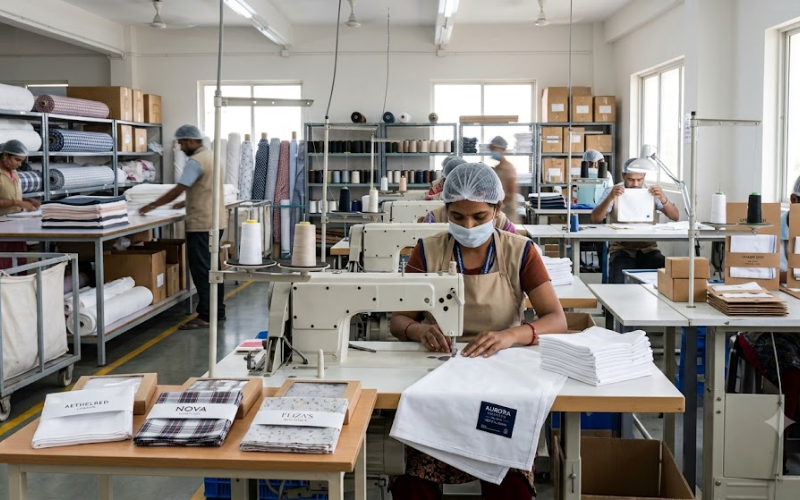
For retailers, apparel brands, corporate buyers and distributors, launching a handkerchief range requires more than simply purchasing finished products. The product needs to match the brand’s target market, quality expectations, design language, packaging requirements and sales channel.
This is where private label handkerchief manufacturing can provide a structured approach.
Instead of developing and producing every stage independently, brands can work with a specialised handkerchief manufacturer to develop products according to defined requirements and sell them under their own brand identity.
Kamal Supers Pvt. Ltd. provides handkerchief contract manufacturing and private-label/OEM manufacturing services, including 100% cotton handkerchief production, pattern design and customisation, size/fabric/colour customisation, packaging, quality testing and bulk production.
What Is Private Label Handkerchief Manufacturing?
Private label manufacturing means a manufacturer produces products for a brand, while the products are marketed and sold under the brand’s own identity.
For handkerchiefs, this can involve developing or selecting:
- Fabric
- Size
- Colour
- Pattern
- Border
- Embroidery
- Finishing
- Packaging
- Labelling
The exact scope depends on the buyer’s requirements and the manufacturer’s capabilities.
Private label production can therefore be useful for brands that want to create a differentiated handkerchief collection without establishing their own manufacturing setup.
Why Choose Private Label Handkerchiefs?
1. Build a Branded Product Range
A private-label handkerchief can become part of a larger men’s accessories collection.
Retail brands can coordinate the handkerchief’s design, colours, packaging and presentation with their existing product range.
This helps create a more consistent customer experience across products.
2. Develop Products for a Specific Market
Different customers may have different preferences.
For example, a retailer may want classic designs for a traditional customer base, while another brand may prefer contemporary patterns and colours.
Private-label manufacturing allows brands to communicate their product requirements to the manufacturer rather than relying only on standard catalogue products.
3. Customise Product Specifications
Kamal Supers provides customisation related to size, fabric, colour and pattern design as part of its contract manufacturing services.
Depending on the project, brands can define product requirements around:
Fabric selection
Finished size
Colour palette
Pattern
Border
Embroidery
Packaging
Branding
The final specification should be agreed upon before production begins.
Private Label vs Standard Wholesale Handkerchiefs
| Factor | Standard Wholesale | Private Label |
|---|---|---|
| Branding | Standard supplier/product branding | Buyer’s brand |
| Product Design | Usually existing designs | Can be customised |
| Packaging | Standard options | Can be customised |
| Product Differentiation | Limited | Greater scope for differentiation |
| Product Development | Minimal | More involvement |
| Suitable For | General resale | Retail brands and dedicated collections |
For businesses testing an established product category, standard wholesale products may be sufficient.
For brands building their own identity, private-label production can provide greater control over the product and presentation.
What Can Be Customised?
One of the major advantages of working with a specialised manufacturer is the ability to discuss product requirements before production.
Fabric
Brands can define the required fabric based on their target market and intended product positioning.
Kamal Supers specifically offers 100% cotton handkerchief manufacturing.
Size
Different sales channels may require different finished dimensions.
For example, a brand may have a predefined size for its existing men’s accessory range.
The required dimensions should be communicated clearly to the manufacturer during product development.
Colour
Colour selection can be based on:
Brand identity
Target market
Seasonal collections
Retail preferences
Existing product ranges
For custom production, colour specifications should be approved before bulk manufacturing.
Pattern and Design
Patterns can significantly affect the positioning of a men’s handkerchief.
Possible directions include:
Classic checks
Minimal patterns
Bold checks
Plain styles
Border designs
Custom patterns
Kamal Supers’ existing cotton checks range includes both subtle and more prominent check patterns.
Embroidery
For certain branded or premium applications, embroidery can be incorporated into the product according to the agreed design.
Kamal Supers states that its manufacturing unit supports custom weaving and embroidery.
The Private Label Manufacturing Process
A structured manufacturing process helps minimise confusion between the brand and production partner.
Step 1: Define the Product
Start by identifying the product you want to manufacture.
Define:
Intended customer
Product category
Fabric
Size
Colour
Pattern
Quantity
Packaging
Branding requirements
A clear product brief gives the manufacturer a better understanding of the project.
Step 2: Discuss Customisation
Share your requirements with the manufacturer and determine which elements can be customised.
This may include fabric, dimensions, colours, patterns, embroidery and packaging.
Step 3: Review Samples
Before bulk production, review a sample against the agreed specifications.
Check:
Fabric feel
Colour
Pattern
Dimensions
Stitching
Finishing
Branding
Packaging
Any required changes should ideally be resolved at the sample stage.
Step 4: Approve the Product
Once the sample meets the agreed requirements, the final specifications can be confirmed for production.
This creates a clear reference for the manufacturing team.
Step 5: Bulk Production
The approved product then moves into bulk manufacturing.
Kamal Supers describes its contract manufacturing capability as supporting large-scale orders and consistent production.
Step 6: Quality Checks and Packaging
Quality testing and production checks help maintain consistency before the products are packed.
Kamal Supers includes quality testing and premium packaging among its contract manufacturing services.
Choosing a Private Label Handkerchief Manufacturer
Selecting the right manufacturing partner is an important part of the project.
Manufacturing Experience
Look for a manufacturer with specific experience in handkerchief production rather than a general textile supplier.
Kamal Supers has been associated with handkerchief and rumal manufacturing since 1987.
Customisation Capability
If your brand requires specific sizes, fabrics, colours or patterns, confirm that the manufacturer can support those requirements.
Quality Control
Ask how samples and production quality are evaluated.
Important areas include fabric, stitching, colour, pattern and finishing.
Packaging Support
Retail brands may require packaging that is ready for their intended sales channel.
A manufacturer offering packaging support can simplify the production workflow.
Bulk Production
If the product is successful, your manufacturing partner should be able to support the required production scale while maintaining agreed product specifications.
Kamal Supers states that its manufacturing services support bulk production and large-scale orders.
Private Label Handkerchiefs for Different Business Segments
Private-label production can support several types of buyers.
Men’s Retail Brands
Retailers can develop branded handkerchief collections using selected patterns, colours and packaging.
Apparel Stores
Handkerchiefs can complement men’s clothing and accessories collections.
A coordinated product range can include shirts, accessories and other everyday essentials.
Corporate Buyers
Businesses may require branded handkerchiefs for gifting, promotional requirements or employee-related initiatives.
Hospitality and Travel
Handkerchiefs can also form part of travel or hospitality kits, where consistent packaging and presentation may be important.
Distributors
Distributors can work with manufacturers to develop products suited to specific customer segments and sales territories.
Questions to Ask Before Placing a Bulk Order
Before confirming private-label production, ask the manufacturer:
- What fabric options are available?
- Can the size be customised?
- Can colours and patterns be customised?
- Can branding or embroidery be incorporated?
- What packaging options are available?
- How are samples approved?
- What quality checks are performed?
- Can the manufacturer support bulk production?
- What information is required to begin product development?
- How will the final specifications be documented?
These questions help establish clear expectations between the buyer and manufacturer.
Why Product Specification Matters
A private-label project can involve many variables.
A buyer may approve a specific pattern, colour and size during sampling, but the same specifications need to be clearly communicated throughout production.
A written product specification can include:
- Product name/code
- Fabric
- Finished dimensions
- Colour
- Pattern
- Border
- Stitching requirements
- Branding
- Packaging
- Approved sample reference
This provides a common reference for the brand and manufacturing team.
Private Label Manufacturing With Kamal Supers
Kamal Supers Pvt. Ltd. provides contract manufacturing services for brands and bulk buyers. Its listed capabilities include 100% cotton handkerchief manufacturing, pattern design and customisation, size/fabric/colour customisation, private-label/OEM manufacturing, packaging, quality testing and bulk production.
The company also manufactures cotton checks handkerchiefs and other product styles, giving buyers options when developing a men’s handkerchief range.
For a brand, the objective should be to define the product clearly, approve samples carefully and establish quality and packaging expectations before bulk production.
Conclusion
Private label handkerchief manufacturing can help retailers, apparel brands, distributors and bulk buyers develop handkerchief collections under their own brand identity.
The process can include product selection, fabric and size customisation, pattern development, colour selection, embroidery, packaging, quality testing and bulk production.
The most important step is to establish clear specifications before production begins. A well-defined product brief and approved sample can provide a clear reference for manufacturing and help maintain consistency across the order.
For businesses looking for a private label handkerchief manufacturer in India, Kamal Supers offers contract manufacturing, OEM/private-label production, customisation, packaging and quality testing for handkerchief products.
